
Deep in the Andean rainforests of Peru, some of the world’s most remarkable biodiversity is still waiting to be discovered—and much of what we already know remains poorly understood.
On September 25, Rainforest Partnership invites you to join Peruvian herpetologist and longtime scientific collaborator Pablo Venegas for a rare virtual journey into some of Peru’s most remote and biodiverse forests.
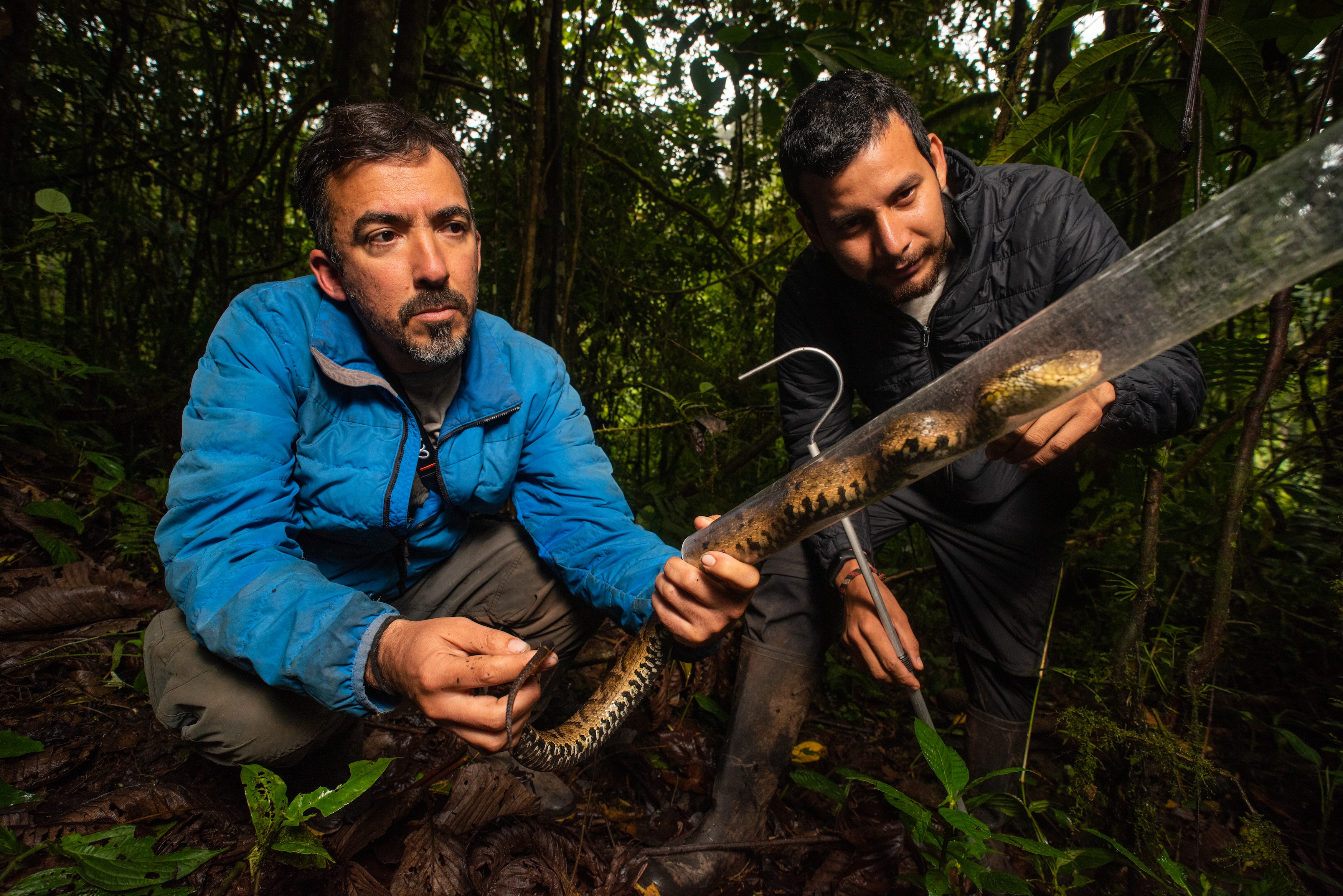
Through photographs, videos, and stories from his expeditions, Pablo will take us behind the scenes of scientific exploration. He will share what it takes to search for frogs, lizards, and snakes in landscapes that are difficult to reach and even more challenging to study.
What is it really like to conduct science in the field?
Biodiversity research in remote forests is far removed from the controlled environment of a laboratory.
Scientists may travel for hours—or days—to reach a field site. They trek through steep and rugged terrain, cross rivers, endure unpredictable weather, and carry the equipment and supplies they need into places with few modern conveniences. Once there, the search requires patience, experience, and careful observation.
A small movement among leaves, an unfamiliar call in the darkness, or an unexpected pattern on an animal’s skin may signal an important discovery.
The result may be a species that is new to science. But expeditions are not only about finding animals that have never been formally described. They are also essential for locating and documenting rare and poorly known species, including some that may face a serious risk of extinction.
When a species lives in a remote or inaccessible forest, scientists may know remarkably little about it. Where does it live? How large is its population? What does it need to survive? Is its habitat disappearing before we have had the opportunity to understand it?
Answering those questions begins in the field.
From a remote forest to the scientific record
The journey does not end when an expedition team leaves the rainforest.
Back at the museum, field observations become part of a much longer scientific process. Researchers may conduct DNA analyses, complete detailed morphological studies, review historical records, and compare their findings with specimens preserved in scientific collections around the world.
These careful comparisons help scientists determine whether an animal represents a new species, a new geographic record, or an important observation of a species that remains poorly understood.
This process turns an encounter in a remote forest into lasting scientific knowledge about species’ distributions, populations, relationships, and natural history.
Discovery as a first step toward conservation
We cannot protect what we do not know exists—and we cannot determine how best to protect a species without understanding where and how it lives.
Scientific expeditions help create the baseline knowledge needed to recognize threatened species, understand the importance of their habitats, and make informed conservation decisions. At a time when forests and wildlife face mounting pressures, this work is both urgent and painstaking.
Pablo’s presentation will offer a firsthand look at the people, places, challenges, and moments of discovery behind that work. Following the presentation, guests will have an opportunity to ask questions about field exploration, herpetology, species identification, and the connection between scientific research and rainforest protection.
Rainforest Partnership CEO Tatiana Kaletsch will welcome guests and introduce the program. The session will be recorded.
Event details
Into the Andean Rainforests: Discovering Peru’s Forgotten Biodiversity
Friday, September 25, 2026
12:00 p.m. Central Time / 1:00 p.m. Eastern Time
Live on Zoom
The one-hour program will include:
- An introduction by Rainforest Partnership CEO Tatiana Kaletsch
- Pablo’s presentation featuring photographs and videos from the field
- A live audience question-and-answer session
Join us for a behind-the-scenes look at exploration, discovery, and the science that turns a journey into the Andes into a first step toward conservation.
RESERVE YOUR PLACE AT THIS LINK
