
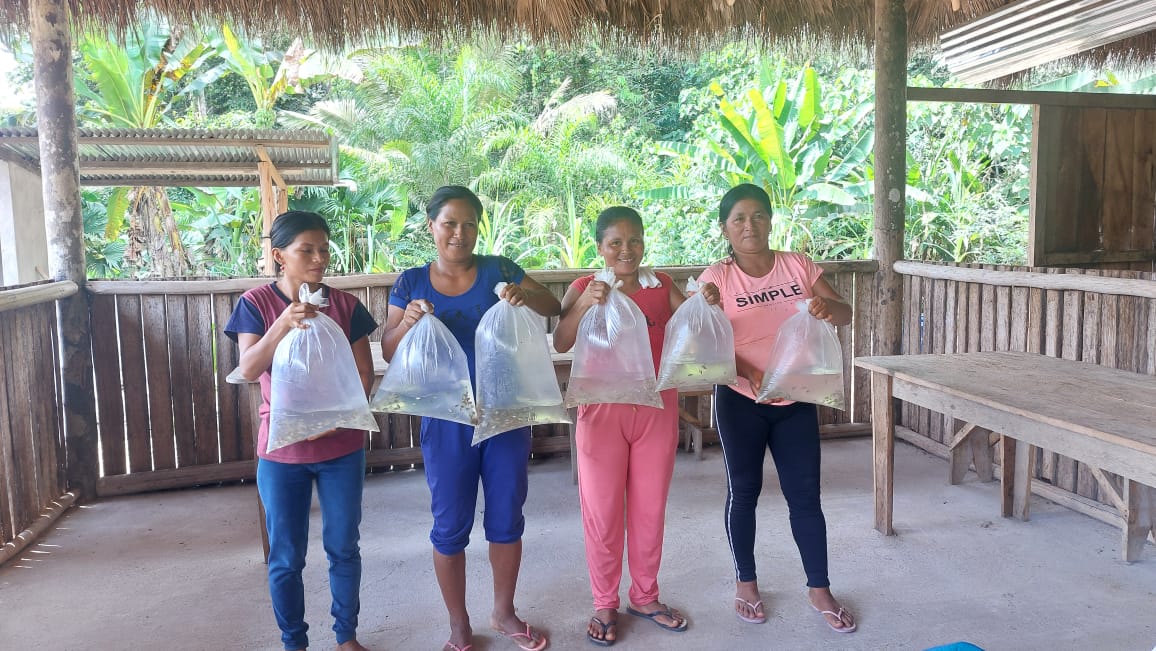
In Ecuador’s Amazon, protecting the rainforest is inseparable from strengthening the communities who call it home.
Along the Napo River, women are creating new opportunities for their families while building stronger community organizations and developing livelihoods that work with, rather than against, the forest around them.
This is the idea at the heart of Rainforest Partnership’s Napo River Women’s Project.
The roots of the project reach back to 2008, when the Sani Warmi women’s organization was formed in the Indigenous Kichwa community of Sani Isla. What began there demonstrated something important: when women have opportunities to organize, lead, and develop their own initiatives, the benefits can extend throughout their families and communities. The work expanded to additional Amazonian communities beginning in 2019.
Today, the project has active initiatives in four communities—Sani Warmi–Sani Isla, Hatun Urku, Munditi Urku, and Isla Flor Amazónico. Approximately 76 women have participated, four community organizations have been strengthened, and six types of sustainable bio-enterprises have been fostered.
.jpg)
More Than Fish Farming
One of the project's most important activities is community-based cachama fish farming.
Fish are an important part of the Amazonian diet, but declining fish populations, environmental changes, and contamination of water sources have created challenges for communities that traditionally rely on rivers for food. Locally managed cachama farming offers another option.
The ponds can help supplement family diets, provide opportunities for additional income, reduce pressure on natural resources, and create a shared enterprise around which community members can organize and build new skills.
But the ponds are only part of the story.
Rainforest Partnership’s work includes community planning, leadership development, organizational strengthening, project-management training, and support for community associations. Other locally appropriate livelihoods have included agroforestry, handicrafts, stingless-bee farming, community tourism, and traditional cuisine.
The objective isn't to arrive with one solution and reproduce it everywhere. Each community has different knowledge, priorities, environmental conditions, and possibilities.
When Women Lead, Communities Grow
Isla Flor Amazónico offers an encouraging example of how that process can evolve.
Women initially led the effort to find new economic opportunities for their families. As the initiative developed, their husbands began participating as well. Together, community members formally established the Ayllu Kawsay Production and Marketing Association, strengthening their ability to manage activities, participate in training, and pursue new partnerships.
That evolution—from an initiative led by women to a stronger organization involving families—is exactly the kind of long-term capacity that community-led conservation requires.
.jpg)
What We Learned on Our Latest Field Visits
In May 2026, our team returned to Munditi Urku, Hatun Urku, and Isla Flor Amazónico to meet with participants and assess progress in fish farming, community participation, and organizational development.
The visits showed both progress and the realities of doing long-term community work.
Women in Munditi Urku expressed interest in continuing the project and developing additional sustainable initiatives. In Hatun Urku, participants identified challenges within their internal organization and took action themselves, electing new leadership to improve participation and project monitoring. Isla Flor Amazónico continued to demonstrate a stable process built around collaboration among women and men.
These aren't dramatic overnight transformations. They are something more durable: communities developing the knowledge, organization, confidence, and experience to increasingly manage their own initiatives.
And that takes time.
.jpeg)
Conservation Built to Last
One lesson from this work has become especially clear: community-led conservation requires consistent partnership.
Technical support and regular field visits help solve problems before they become larger, strengthen skills, maintain momentum, and—perhaps most importantly—build trust. Our goal is not permanent dependence on outside assistance. It is the opposite: sustained support that helps organizations gradually develop greater autonomy.
That is why strengthening livelihoods and strengthening the rainforest cannot be separated.
When communities have sustainable ways to support their families, strong local organizations, and the ability to make decisions about their own futures, they are better positioned to protect the landscapes and natural resources on which they depend.
For the women of the Napo River Project, that future is being built one pond, one meeting, one organization, and one community at a time.
